
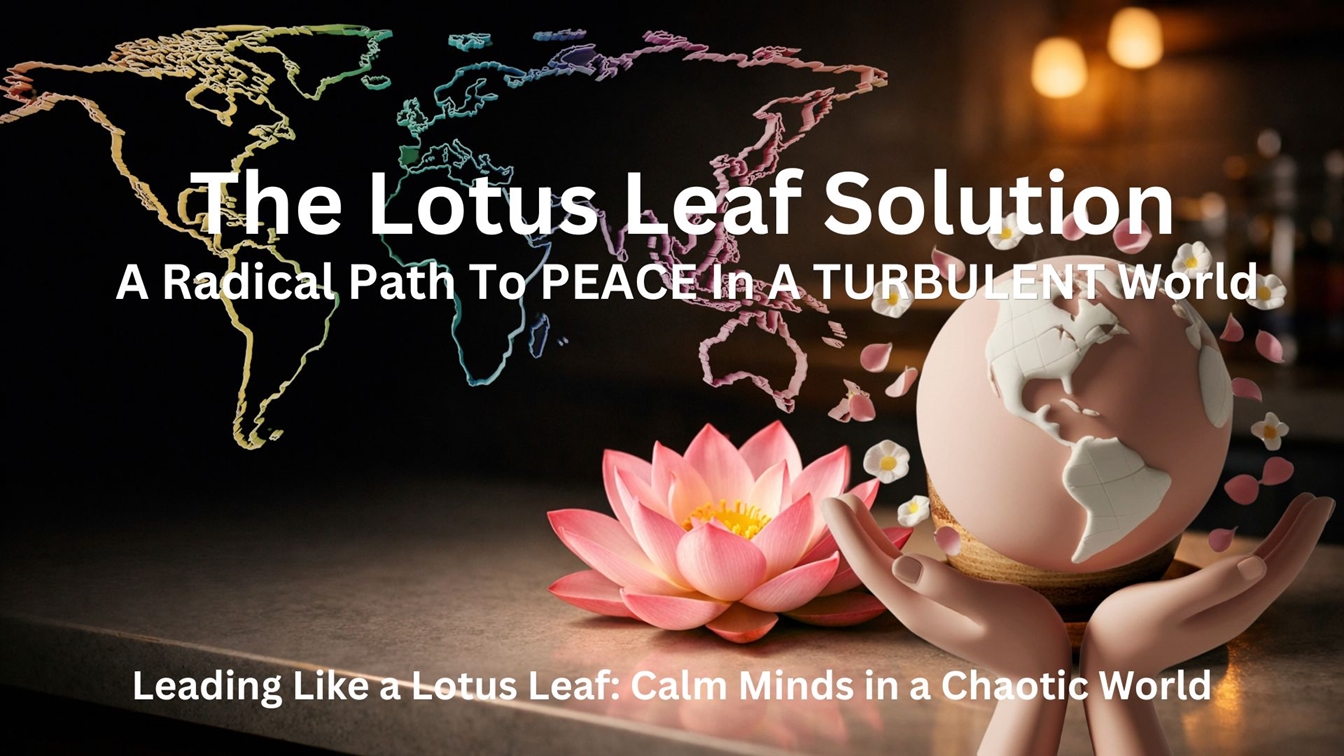
The Peace Strategy To End Wars: The Courageous Approach Leaders Have Yet to Try
In a world rattled by crises—geopolitical tensions, economic instability, supply chain breakdowns, and the constant hum of conflict—humanity is desperately searching for solutions that actually work. This blog dives into a radically different approach The Resonant Clarity Framework: flowing from the Lotus Leaf Principle from the Bhagavad Gita, embraced and taught within ISKCON, the Golden Rule Principle from Abrahamic texts, and the contemporary Law of Attraction.
Far from being abstract spiritual metaphors, the three principles offer a counterintuitive blueprint for navigating global chaos without becoming consumed by it. What happens when we apply this ancient triage of “engaged detachment” to modern warfare, political hostility, and the psychological burnout of living in a hyper-reactive world?
This post challenges the reader to rethink everything they assume about peace, leadership, and human behavior. It argues that while diplomacy and policy shape the battlefield, consciousness shapes the world that creates those battlefields in the first place.
Is it possible that the most overlooked tool for ending hostility isn’t military strength or political negotiation—but a shift in how individuals and leaders relate to power, ego, and fear?
This is not a call for passivity. It’s a call for clarity, courage, and a new kind of inner resilience. A lotus leaf stays afloat in turbulent waters. Maybe humanity can too.
In an age defined by turbulence—wars, economic instability, global supply disruptions, and a constant sense of collective anxiety—humanity keeps returning to the same question:
Why can’t we find lasting peace?
The Resonant Clarity Framework
1. The Leadership Shift Humanity Is Afraid to Make: The Lotus Leaf Principle
We build alliances, negotiate treaties, impose sanctions, and deploy armies. Yet the cycle of hostility continues, reshaping itself in new forms every decade. The world is searching for solutions, but perhaps the most transformative one has been sitting quietly in plain sight for thousands of years.
It is the Lotus Leaf Principle, a teaching from the ancient Bhagavad Gita, which offers a radically different way of engaging with conflict, power, and responsibility.
This principle is not political. It is not ideological. It is human.
🌿 What the Lotus Leaf Teaches Us
A lotus leaf floats in water yet remains untouched by it. The Gita uses this image to describe a person who acts in the world without becoming entangled in ego, anger, or fear.
When the doership (“I am doing this”) is surrendered, actions do not leave impressions or bind the individual, allowing them to remain peaceful and choose actions that reflect compassion rather than control.
This is not detachment in the sense of apathy. It is engaged clarity. And is beautifully reflected in the contemporary Law Of Attraction- war breeds war, peace breeds peace. You get what you focus on.
So What Does This All Mean?
acting with responsibility but without ego
making decisions without being clouded by hatred
responding to crises without being consumed by them
leading without being driven by personal gain or emotional reactivity
Imagine leadership rooted in that mindset. An end to the need to control, be it in the home, community or country.
2. The Golden Rule: Reciprocity as a Strategic Advantage
Often dismissed as simple moral advice, the Golden Rule is actually a high‑performance leadership tool. Treating others with the respect and fairness you expect in return creates psychological safety—an essential ingredient for collaboration, trust, and conflict resolution.
In environments where pressure is high and stakes are global, reciprocity becomes a strategic asset. It opens doors that force cannot, and it builds alliances that endure beyond crisis.
3. The Law of Attraction: Mindset Shapes Outcomes
The Law of Attraction is frequently misunderstood, but at its core it reflects a truth backed by behavioral science: leaders set the tone. Their mindset influences the energy, expectations, and emotional patterns of the people around them.
A leader who operates from fear spreads fear. A leader who operates from clarity spreads stability.
This principle reminds leaders that their internal state is not private—it’s contagious.
Why The Resonant Clarity Framework Matters Now
Traditional leadership strategies often focus on external actions: policies, negotiations, or tactical decisions. But in an age where conflict spreads through emotion as quickly as through politics, mindset has become a strategic variable.
The Resonant Clarity Framework offer leaders a way to:
Reduce hostility instead of amplifying it
Create conditions for dialogue instead of division
Model steadiness that cascades through teams and communities
Influence peace from the inside out
If we want to build a more stable world—and ultimately end cycles of conflict—we need leaders who can regulate themselves as effectively as they manage others.
🌍 Can You End Wars?
fear-driven narratives
retaliatory thinking
historical grievances
competition for resources
national pride
the pressure to “win” rather than resolve
These forces create a world where reactions often overshadow reflection.
The Lotus Leaf Principle together with the Golden Rule and Law of Attraction, offer a counterbalance. It suggests that the greatest strength is not dominance, but inner steadiness, morality and focus on peace.
A leader who embodies these principles:
listens before reacting
seeks solutions instead of victories
refuses to dehumanize opponents
acts from duty, not ego
remains calm in the face of provocation
This is not weakness. It is a beautiful meld of a deep dedication to a peaceful future where everyone co-creates and thrives.
🕊️ Could This Approach Reduce Global Hostility? And End Wars?
No single philosophy can erase geopolitical complexity. But the essence of these principles can shift the psychology that fuels conflict.
1. It reduces emotional escalation
Most conflicts intensify because leaders and populations react from fear or anger. A lotus-like mindset interrupts that cycle.
2. It encourages ethical decision-making
When ego is removed, decisions become clearer, more humane, and more sustainable.
3. It promotes long-term thinking
Detachment from short-term political gains allows for solutions that prioritize future generations.
4. It strengthens diplomacy
A calm mind negotiates better than a reactive one.
5. It inspires trust
People follow leaders who are steady, compassionate, and principled.
This principle does not replace diplomacy, law, or international cooperation. It enhances them.
🌱 Why It Requires Courage To End Wars Be It Within Families, Religions or States?
Adopting the Lotus Leaf Principle is not easy. It demands:
humility
self-control
the ability to withstand criticism
the willingness to break from old patterns
the strength to choose restraint over retaliation
- the wisdom to feel compassion than control
It is far easier to react than to reflect. Far easier to escalate than to de-escalate. Far easier to cling to ego than to rise above it.
But history shows that the most transformative leaders—across cultures and eras—were those who mastered themselves before attempting to influence the world.
Leonardo da Vinci: Primarily an artist and scientist, he viewed self-management as the ultimate skill, noting, “There is no smaller or greater mastery than mastery of oneself”.
Confucius: Famously asked, “How will he who does not know how to govern himself know how to govern others?” emphasizing that personal moral discipline is the foundation of just leadership
Aristotle: Taught that “He who cannot be a good follower cannot be a good leader,” suggesting that the humility and discipline learned through subordination are essential for authentic authority.
Ashoka the Great: A ruthless conqueror who underwent a profound personal evolution after witnessing the horrors of war. He mastered his aggressive impulses and transitioned into a promoter of non-violence and moral governance, effectively reshaping the destiny of ancient India through his internal change.
🌏 A Call for a New Kind of Leadership To End Wars
The world does not need leaders who are detached from responsibility. It needs leaders who are detached from ego.
Leaders who can stand in the storm without becoming the storm. Leaders who can act decisively without acting destructively. Leaders who can see humanity even in those they disagree with.
This trio of principles is not a political strategy. It is a consciousness strategy.
And consciousness shapes everything.
🌸 The Lotus Leaf as a Global Metaphor
If a lotus leaf can remain untouched by the water that surrounds it, perhaps humanity can learn to remain uncorrupted by the hostility that surrounds us.
This is not idealism. It is a challenge. A discipline. A courageous experiment the world has not yet tried at scale.
And maybe—just maybe—it is the shift we have been waiting for.
What do you think is the biggest driver of modern conflict—geopolitics, economics, or leadership reflexes?
UPCOMING PODCASTS: The Resonant Clarity Framework
🎧 Episode 1 — For Educated Professionals (Workplace)
Resonant Clarity at Work: How to Stay Unshaken in High‑Pressure Environments
🎧 Episode 2 — For Communities (Families, Groups, Social Circles)
The Community Ripple: How Resonant Clarity Strengthens Relationships and Reduces Tension
🎧 Episode 3 — For Governments & Diplomacy
Mindset as Strategy: Resonant Clarity for Leaders Navigating Conflict and Negotiation