
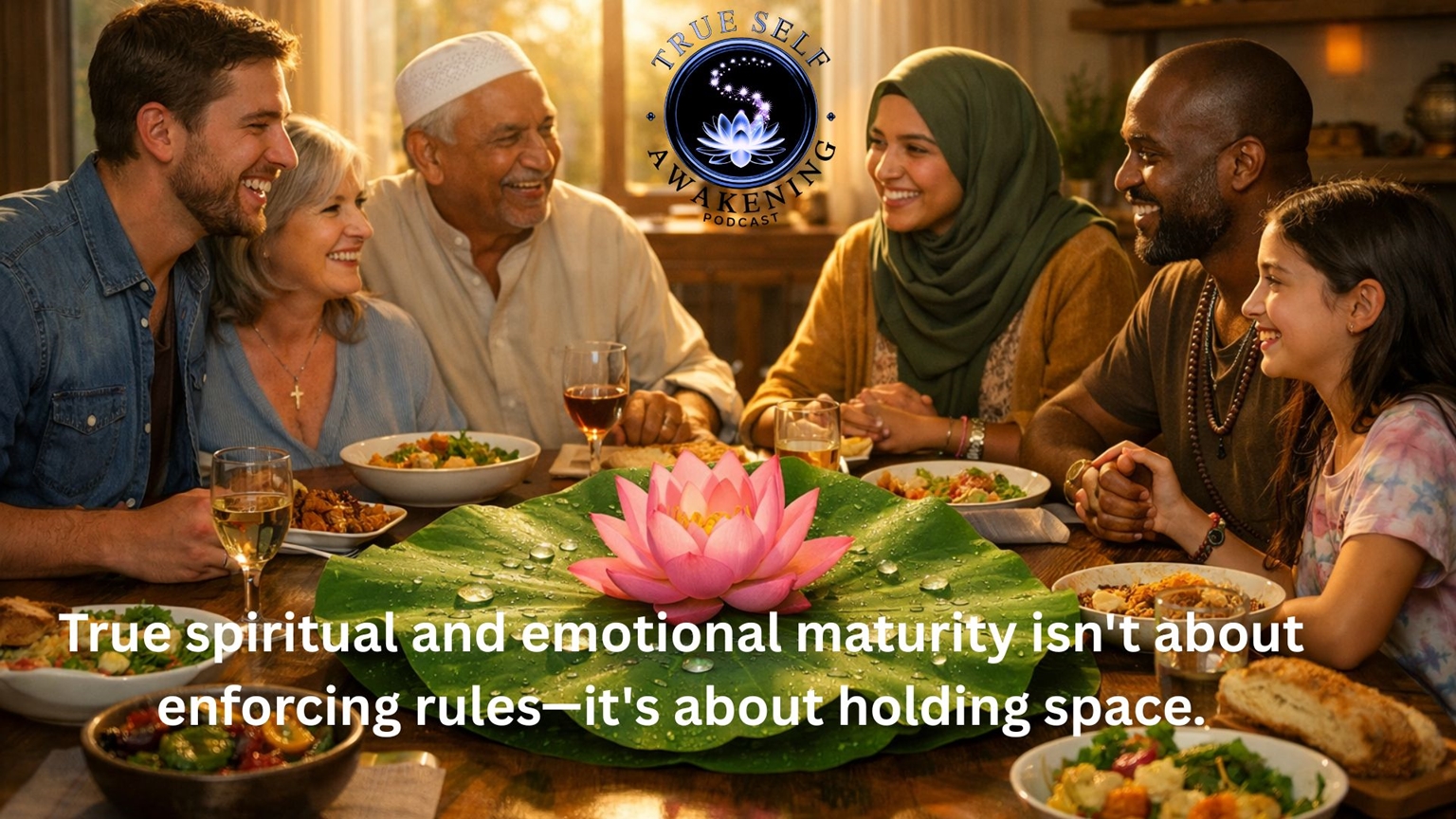
Duty, Motive, and the Lotus Leaf Principle
In a recent case of new found beliefs versus family cohesiveness we discuss the actualities of everyday life, and how individual inner peace can be the route to peaceful families, communities and countries.
If you are navigating the complexities of your spiritual journey, you may often encounter a painful friction between your personal sadhana (disciplined practice) and your obligations to those you love or to the communities or nation you serve. When you firstly ask yourself: what does the Divine/Source, that non-physical power, truly create all living beings for? You will find your answer.
Does spiritual progress require the sacrifice of our family’s (or nation’s) well-being on the altar of rigid rules or beliefs?
This recent case of a family torn apart due to opposing spiritual beliefs, we dive into the ancient Indian Vedic tradition, particularly within the timeless wisdom of the Bhagavad Gita, to find that the most profound growth occurs not through the external imposition of prohibitions, but through the internal refinement of our motives. This is the “Alchemy of Action”—the process of transforming mundane tasks into liberating service.
1. The Paradox of Piety: When Control Becomes a Prison
Let us consider the weight of a silence that has become suffocating. In a quiet suburban home, a father and his sons sit huddled over a kitchen counter in the dead of night. They move with the hurried, rhythmic precision of thieves, terrified that the clatter of a fork or the crinkle of a wrapper might wake the woman of the house. They consume food that is often cold or entirely uncooked, desperate to satisfy their hunger without leaving a trace.
This “Secret Kitchen” is a domestic underground born not of necessity, but of a misplaced piety.
The mother, a sincere seeker and recent Hare Krishna ISKCON initiate, has transformed the family home into a space of strict prohibition, banning all non-vegetarian food with the “iron fist” of a new convert. While her heart yearns for shuddhi (purity), the result is a house divided.
Case Study: The Fractured Home
- The Controller: A mother whose sincere desire for spiritual purity has morphed into a rigid dietary regime enforced upon her household.
- The Victimization: A husband and children who are tortured from lack of food they desire sink into darkness of depression.
- The Spiritual Verdict: Seeking an intervention, the family’s grandmother consulted a +70-year-old senior Guru. The verdict was shocking but abundantly clear: a practitioner’s primary spiritual success, or Stri-dharma, is measured by the ability to care for and satisfy the family, not to rule as a “theocratic dictator.”
The Heart of the Matter: When external religious rules are forced upon others for perceived spiritual gain, the result is darkness rather than enlightenment. True spirituality should liberate a household, creating an atmosphere of grace; when it creates “walls of secrecy and suffering,” it ceases to be a path to God/the Divine and becomes a prison of the ego.
The tragedy of this domestic failure reveals a profound misunderstanding of the very nature of consciousness itself.
2. Redefining Purity: The Lotus Leaf Principle (Bhagavad Gita 5.10)
The mother’s rigid stance often stems from a profound fear of karma—the dread of “sinful reactions” attached to handling material things she now deems impure.
However, Bhagavad Gita 5.10 offers a powerful shield for the seeker: the Lotus Leaf Principle. Just as a lotus leaf remains perfectly dry while floating in the water, a person who performs their duty without personal attachment remains “spiritually untouched” by the material world. Only positive karma ensues.
One who performs his duty without attachment, surrendering the results unto the Supreme, is not affected by sinful action, as the lotus leaf is untouched by water.
Feature | Material Purity (External Rules) | Spiritual Purity (Internal Motive) |
Primary Focus | The “What”: Strict adherence to dietary laws and prohibitions. | The “Why”: The underlying intention and spirit of service. |
Governing Method | Control, bans, and the “iron fist” of external enforcement. | Dharma (duty), compassion, and detachment from results. |
Relational Outcome | Often leads to ego, secrecy, and family fragmentation. | Grants “spiritual immunity” and maintains internal harmony. |
Spiritual Mechanism | Avoiding “impure” objects (e.g., meat) to stay clean. | Acting out of service to others rather than personal desire. |
The Essential ISKCON Lesson: Spiritual “immunity” comes from the motive of an action, not the material nature of the objects handled. If a practitioner prepares food for her family because it is her mandatory duty to care for their health—rather than a desire to satisfy her own palate—she remains untainted by negative karma. The soul is protected by the purity of the service, not the contents of the menu.
This internal immunity, however, does not exist in a vacuum; it should be expressed through the map of your daily obligations.
3. The Map of Duty: Choosing Service Over Perfection (BG 3.35 & 2.47)
The Bhagavad Gita provides a clear compass for navigating the conflict between personal ideals and household responsibilities. The wisdom of the Gurus reminds us that spiritual maturity is found in serving people rather than policing them.
- Prioritize Mandatory Duty over Elective Standard (BG 3.35): The presiding Guru in this text, Krishna, teaches that it is far better to perform one’s own duty (dharma)—in this case, the maintenance and well-being of the family—even if it is performed “imperfectly” by religious standards, than to follow another’s path perfectly. Caretaking is a mandatory duty; enforcing a specific diet on unwilling participants is a personal choice.
- The Sovereignty of Action over Results (BG 2.47): The text instructs: “karmaṇy-evādhikāras te mā phaleṣhu kadāchana“—your right is to the work alone, never to its fruits. A practitioner must focus on the act of compassionate service and leave the “result”—the eventual spiritual evolution of their family—in the hands of the Divine.
The Heart of the Matter: A “perfect” vegetarian kitchen that results in a starving husband and depressed children is not a spiritual achievement; it is a spiritual failure. Realizing this requires the humility to see that we cannot drive our loved ones toward a different view through force; we can only invite them through the quality of our own character.
This principle is not merely theoretical; it was lived with exquisite grace by one of the ISKCON tradition’s most respected figures.
4. The Power of the "Open Kitchen": The Example of Pisima
Pisima, the sister of the founder of ISKCON and saint Srila Prabhupada, serves as the ultimate rebuke to the “iron fist” of piety. A devotee of the highest caliber, she did not maintain a “Secret Kitchen” that forced her family into the shadows. Instead, she maintained an “Open Kitchen” of love.
- Duty Over Dogma: Despite her own lifelong, strict vegetarianism, Pisima continued to cook fish for her husband. She recognized that her primary dharma was his happiness, not to coerce his conscience.
- Love Over Force: She understood that bans and prohibitions only drive loved ones into the dark corners of the home to eat in secret. She chose to be present in his life rather than a judge of his plate.
- Transformation Through Service: Ultimately, her unwavering devotion and spirit of sacrifice did what rules never could—her love eventually transformed her husband’s heart, a change born of attraction rather than compulsion.
The Essential Lesson: Pisima’s example proves that service builds bridges that allow goodness to cross into the lives of others. Force, by contrast, only builds walls that keep goodness out.
The Macro-Crisis: Why Control Backfires in Society and Globally
When we scale these domestic insights from the ancient text to the general level of communities and nations, we see a recurring tragedy.
When “devotion” to perceived or self-imposed principles is used to restrict others who have different beliefs, just for the sake of one’s own perceived needs/fears it is no longer selfless devotion—it is “ego dressed in religious/state robes.”
“When our ‘devotion’ to an ideal creates walls of secrecy and suffering, it is no longer devotion—it is ego dressed in impostor roles.”
This “theocratic -autocratic-dictatorial” approach to life does not only harm the family or people ; it destroys the controller. The mother in our case study, while seeking God, is actually “wasting away” spiritually. Her heart is becoming a desert of policing rather than a garden of prayer. By focusing on the “sin” of others, she loses the joy of her own connection to the Divine.
Communities and nations that rely on the restriction of others ultimately create a “house/nation divided” that cannot stand, for they have sacrificed the heart of humanity—compassion—for the husk of beliefs—control.
The Heart of the Matter: The walls of secrecy built in a kitchen are the same walls that restrict the life and fulfillment of nations.
Control backfires because it prioritizes the “iron fist” of rules over the transformative power of every soul’s free will.
Parting Insight: Choosing the Path of Awakening
The essence of the Bhagavad Gita’s teaching on action is that inner progress is not a checklist of prohibitions to be imposed on the world. Instead, it is a measure of how much more deeply we can love and serve those who have been entrusted to our care.
True self awakening is found when we:
- Embrace the Lotus Leaf Principle to enhance our inner progress through the holiness of our motives.
- Prioritize selfess service and care over the ego’s desire to control the environment.
- Understand that the path to the non-physical is paved with compassion, not coercion.
Spiritual maturity is the realization that we live to be creators, not masters; to be bridges, not barriers.
A Final Reflection: As you look at your own life and your own “kitchen,” be it your family, your community or your country, ask yourself: Is your path to self-awakening building a bridge to your loved ones, your communities, or nations, or a wall between you? Your emotions are always your best indicator.